New purpose for the High Kirk

The contraction of church congregations in today’s secular age is resulting in many architecturally and historically important ecclesiastical buildings becoming redundant. Churches are significant elements of townscape; yet they can be difficult—in practical and economic terms—to convert to other uses.

The Civic Trust is therefore pleased to see proposals presented to enable what was latterly St David’s High Kirk to be converted to eight flats (Dundee City Council planning references 23/00388/LBC and 23/00389/FULL).

The High Kirk is one of the city’s most familiar and prominent buildings. Erected as the United Free High Church in 1877-78, to the designs of local architect James Ireland of the practice Ireland and Maclaren, it originally stood in isolation on the slopes of the Law at the top of what was then called Hospital Wynd (now Kinghorne Road) and almost directly above the disused tunnel of the Dundee and Newtyle Railway.

Read Newsflash 59

Spring is here; and our 59th issue of Newsflash brings a fresh crop of items to provoke thought about developments in Dundee, along with some interesting historical content.

Open this page and click here to read more.

Newsflash 58 is here

Our February 2023 Newsflash marks the 50th anniversary of Dundee Civic Trust. As ever, it also covers a number of other developments (good and not-so-good) affecting the Dundee urban scene.

Open this page and click here to read it.

50 years of Dundee Civic Trust

2023 marks the fiftieth anniversary of the foundation of Dundee Civic Trust. The Trust was formed in February 1973, when the post-war reshaping of the city was nearing its conclusion and the resultant sacrifices made in terms of lost architectural heritage were becoming clear. This was also the year in which the penultimate edition of the Dundee Directory was published. In its review of 1972, the Directory states that:

“The city’s most familiar sound became the roar of bulldozers. Vast areas of property in the older parts of the city were razed including almost the whole area between King Street and Victoria Road, and large tracts in Lochee and the Watson Street area. The city at the end of the year was beginning to resemble a vast builder’s yard.”

Our picture shows the Dundee into which the Civic Trust was born: a view of the cleared Wellgate, looking down from the steps towards the Cowgate. Now the Wellgate Centre, which stamped its heavy footprint upon this scene, has an uncertain future.

The world of 1973 was so different from 2023 that one is reminded of the quote from “The Go-Between”, by L P Hartley: “The past is a foreign country: they do things differently there.” Some things, however, are not that different. Elected representatives and local government officials don’t always get it right. The local media have been inclined to occasionally portray the Civic Trust as a “watchdog” and we would like to think that an appropriate description. In the third decade of the 21st century, the work of community organisations like ours is as important as ever.


Site 6 – Public Consultation Update

The public consultation event in connection with the latest proposals for Central Waterfront Site 6 will take place at 3 pm on Tuesday 31 May 2022 at Dundee House. For those unable to attend, the display boards may also be viewed on the Cooper Cromar website here.

A further event has been scheduled for Tuesday 21 June, also at Dundee House.

Stirrings on Site 6

Following abandonment of plans to establish a Marriott Hotel on Central Waterfront Site 6, a new Proposal of Application Notice has been lodged for the vacant part of the site to the east of Agnes Husband House (Dundee City Council reference 22/00251/PAN).

The applicant is Robertson Construction Tayside, in association with Cooper Cromar Architects of Glasgow. The proposal is described as a major development comprising phased development to deliver office accommodation and residential units, along with other commercial uses (Use Classes 1, 2 and 3), access and parking.

As part of the public consultation, more detailed plans are expected to be revealed at two events (dates to be confirmed) at Dundee House. There will also be an online exhibition. Members of the public are encouraged to participate and give their views.

Agnes Husband House is the controversial office block, now occupied by Social Security Scotland, which stands opposite the V&A and Dundee station. The Trust objected to this development on grounds of its height and indifferent design qualities, amongst other things. We hope the visual standard of the new elevations on the site may be more pleasing to the eye than Agnes Husband House, although admittedly that is not a high bar to clear.

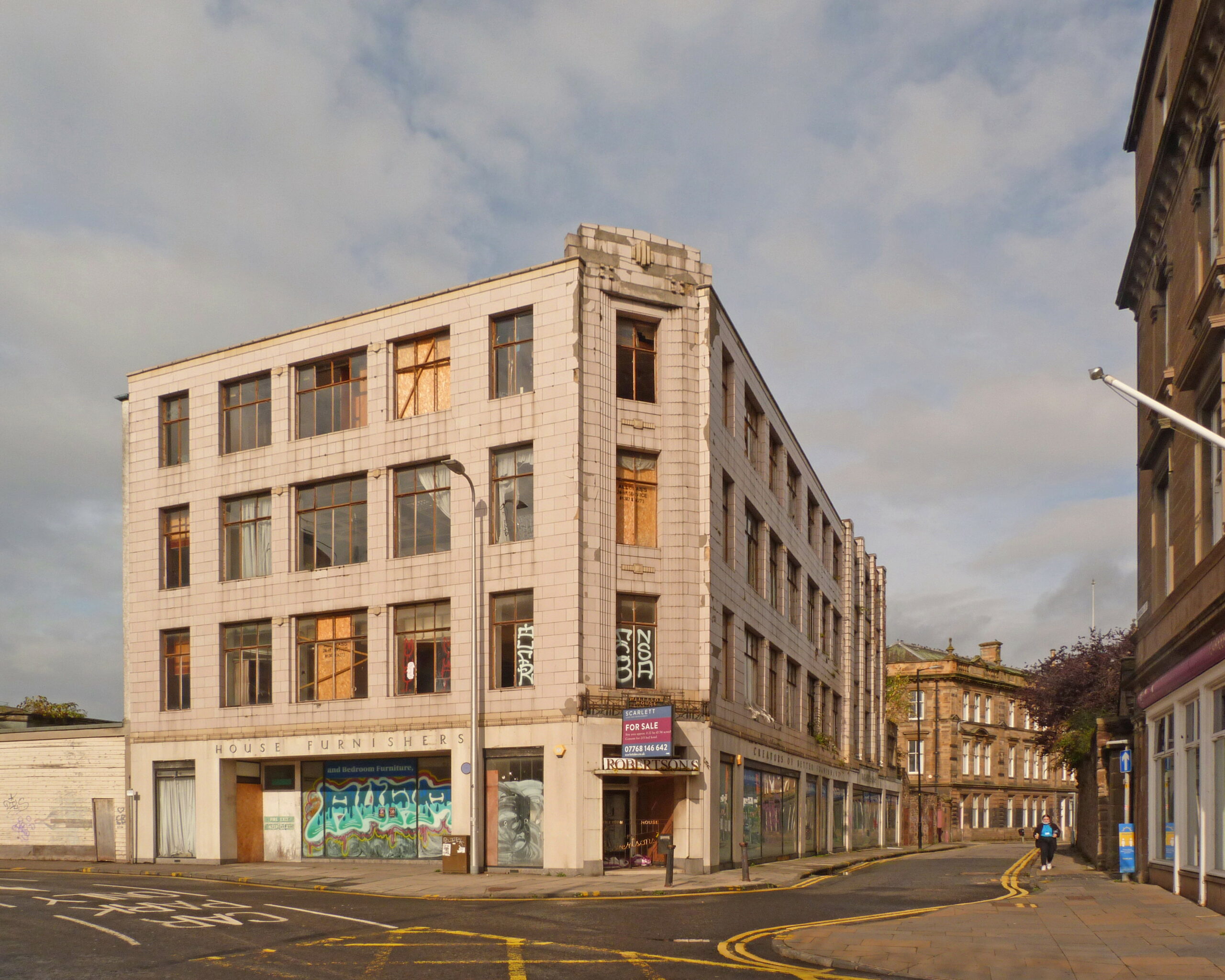
Will Willison House find a new use?

The Category B listed Willison House at 56 Barrack Street dates back to 1934. This distinctive Art-Deco building was erected in the shadow of the massive Ward Mills and served as the retail premises of John L Robertson Ltd, house furnishers, until its abandonment about ten years ago.

After at least one false start, fresh plans involving the retention of the Barrack Street and Willison Street faience facades have been made. Edinburgh-based property firm KR Developments seeks to use the site for purpose-built student accommodation. You can view and participate in the public consultation (which closes on 21 April 2022) here.

Our planning group is examining the proposals, which appear to involve the addition of a tall masonry extension and ‘glass box’, similar to the nearby Dundee House.

Eagle Mills plans

We note a recent application (22/00078/LBC) for listed building consent to convert the western half of the former Eagle Jute Mills to 34 apartments, an internal courtyard, a commercial unit and a basement apparently to be used for plant research. This is Phase 2 of redevelopment of this extensive site enclosed by Dens Road, Lyon Street, Brown Constable Street and Victoria Street. Phase 1 (covering the eastern half) was approved in 2018, but work does not seem to have started.

The oldest part of the complex (now Category B listed) dates from 1864 and was originally Baxter Brothers’ engineering works, where mill machinery was manufactured. In 1930 the site was converted to a jute spinning mill for Low and Bonar. The ‘eagle’ name seems to date from this time, although the familiar wooden aquiline effigy once a feature of the Dens Road/Victoria Street corner was a much later addition.

Many examples of Dundee’s industrial heritage have been rescued through a remarkably successful series of restoration projects since the early 1980s. Upper Dens, Camperdown Works, Tay Works, the Coffin Mill and, most recently, the hotel/apartment development at Lower Dens all have their place here. After the recent sad loss of Wallace Craigie Works, let us hope a secure future can be found for the Eagle Mills.

Plans for solar energy at James Hutton Institute

An application has been submitted by the Dundee Renewable Energy Society for an array of solar panels on a 6.25 ha site north of the A90 opposite Bullionfield to supply power to the James Hutton Institute, estimated at over 25 per cent of their considerable energy use. The plans involve changes to access from the A90, under which the cables would pass, and removal of a considerable amount of woodland. The applicants propose some replanting and state that the visual impression will remain of a wooded site, as a strip of trees alongside the A90 would be retained.

Our planning group will be examining the proposals in more detail.

The application reference is 21/00670/FULL.